Coffee Stains: Traces of People’s Happiness
Written by Moye Liu 22048986
My project is about coffee stain. I spent these weeks observing a small coffee shop. I using scanning and photography to document the coffee stains that appeared at different hours of the day. Like Perec wrote, “Sitting in a café or walking in the street, notebook and pen in hand, I do my best to describe the houses, the shops and the people that I come across” (Perec and Sturrock, 1997, p.47). I try to keep something before it’s wiped away — a small proof that I was there.Each mark—whether a splash, a ring, or a blur—was a residue of movement: a gesture, a pause, a mistake. Documenting these coffee stains allow me to transform them into graphics, to truly connect with the place. As the brief said, graphic design can be a tool that we can seem as a form of inquiry—a tool for looking and thinking critically in our daily life.

In the morning, coffee stains looked like jet-like patterns; At noon, they accumulate like circles, layer upon layer; In the evening, they become almost nonexistent; And at night, they vanish completely under the cleaner’s mop. Through this pattern, I began to interpret the coffee shop as a system of visibility,
documenting the locations of coffee stains showed at what place in the coffee shop and the movements of the cleaners. As Perec said when observing the streets and bus routes in Paris:
“Decipher a bit of the town. Its circuits: why do the buses go from this place to that? Who chooses the routes, and by what criteria?” (Perec , 1997). My observations in the coffee shop also adopted a similar logic: the appearance and disappearance of coffee stains seemed to record the“routes” and rules of this space. I discovered that what remains and what disappears are not neutral decisions but reflections of social order. The cleaners’ labor ensures the visual and experiential comfort of others while leaving no visible trace of themselves. Therefore, the removal of stains exposes the level of existence—whose traces are tolerated and whose are erased.
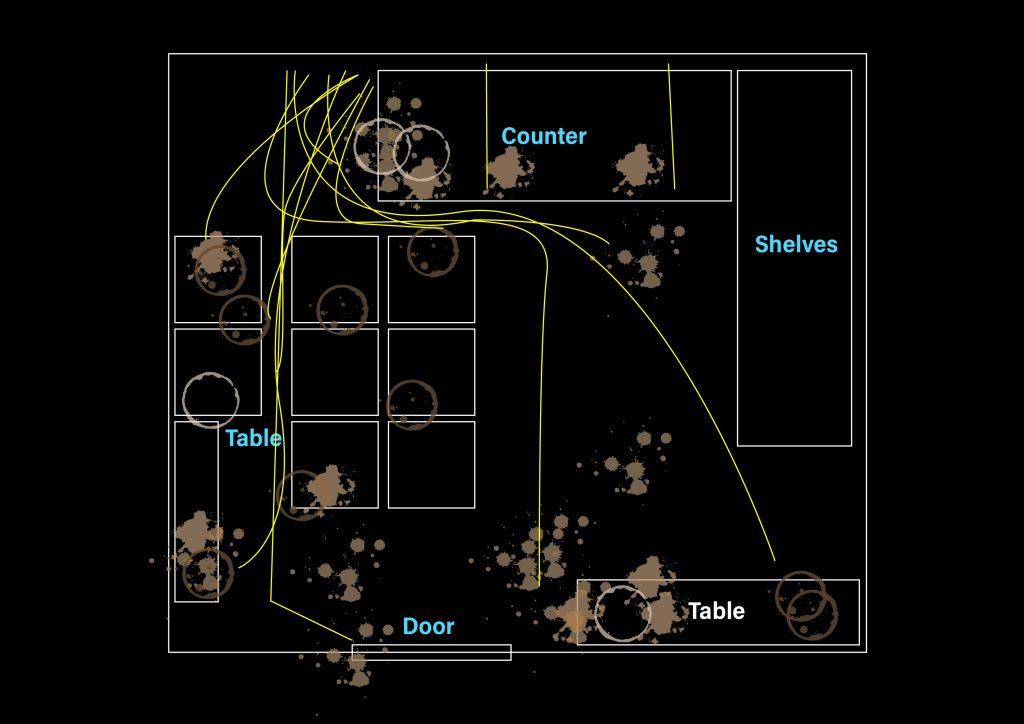

When I compared these cycles to people’s shifting moods throughout the day, I discovered that coffee stains grow larger as the sense of happiness and disappear as calm returns. Some people don’t think their moods would change after spilling coffee. So I think the mood changing by coffee stain still depend on the individual. Cleaners are the most affected by coffee stains, requiring repeated wiping, day after day, to maintain others’ happiness. Therefore, happiness is less a feeling than a controlled state, maintained through constant erasure.
Through these investigations, I’ve become more aware of how fragile and short the traces we left. Watching a coffee stain fade feels like watching a memory fade. It made me think about how much our “clean” urban lives rely on hiding the messy that proves our presence. Perhaps this brief has led me to consider graphic design as a way to preserve these subtle traces of life—to draw our attention to them before they disappear.
Reference list
Georges Perec and Sturrock, J. (1997). Species of spaces and other pieces : Georges Perec. London: Penguin.
Leave a Reply